Google’s product-review upload help now explicitly includes Merchant API as a submission option. That is a useful prompt to review how your store delivers review data, but it does not establish that the API itself has just launched. Search Engine Roundtable reported the documentation change on 18 September 2026.
For ecommerce and technical SEO teams, the practical question is whether an API would solve a real operational problem: unreliable updates, unclear ownership or difficulty keeping review records aligned with the catalogue.
What the official documentation confirms
Google’s current Merchant Center upload instructions describe API delivery alongside file-based methods, including scheduled fetch. An existing, reliable file workflow does not need replacing simply because the help page now presents another option.
The timing matters. Google’s Reviews release notes record a beta launch in October 2024 and a further program-management update in February 2026. The evidence supports a September help-document update, not a September launch announcement.
Access also needs checking before development starts. The current product-review API guide lists an active product-review feed, Product Ratings enrollment and an allowlist request among its prerequisites. A product-review feed is separate from the ordinary product feed.
Who should reassess their setup?
Start with the team that owns review delivery today. If a review platform or aggregator manages it, ask what reaches Google, how failures are surfaced and who handles corrections. Building a second integration without understanding the first creates an ownership problem before it solves a data problem.
A custom integration may be worth evaluating when your organization controls the review records and needs closer coordination with catalogue or platform changes. Conversely, a dependable scheduled export may remain the simpler choice when the team has little engineering capacity to maintain another service.
Treat these as operating-model decisions. Compare the work needed to maintain the current route with the work needed to build, monitor and support an API connection.
A checklist before changing delivery
- Confirm eligibility and access. Record the Merchant Center account, program status and the person responsible for completing any access requirements. Do not schedule a cutover around an assumption that every account can use the API immediately. Check the current developer guide before committing engineering time.
- Trace a review back to its product. Compare the identifiers in the review system with those in the product catalogue. Google’s Product Ratings policies require consistent product identifiers and coordination with an aggregator where one is involved. Include catalogue and review-platform owners in this check.
- Choose one authoritative record. Document where the complete review lives, which system can amend it and how a correction reaches Google. The API guide warns that an insert used to create or update a review replaces the entire resource. Build the submission from a complete record rather than treating that operation as a partial edit.
- Plan the lifecycle, not only the first upload. Write down what should happen after collection, correction or a legitimate removal. Assign someone to reconcile the source records with the submitted data. Validate representative payloads against a complete export before changing live delivery, so missing fields are found early.
- Keep policy checks in the workflow. Google requires comprehensive review sharing, including low-star reviews, and restricts duplicate submissions. An API connection must not become a mechanism for selecting only favorable feedback. Review the current policies with the person responsible for review collection and moderation.
- Define the handover and recovery plan. Agree who receives failure alerts, how an unsuccessful update is investigated and when the existing route can be retired. Keep a written record of the cutover decision, the data reconciled and the unresolved exceptions. Assign ongoing ownership before launch.
What this update does not tell you
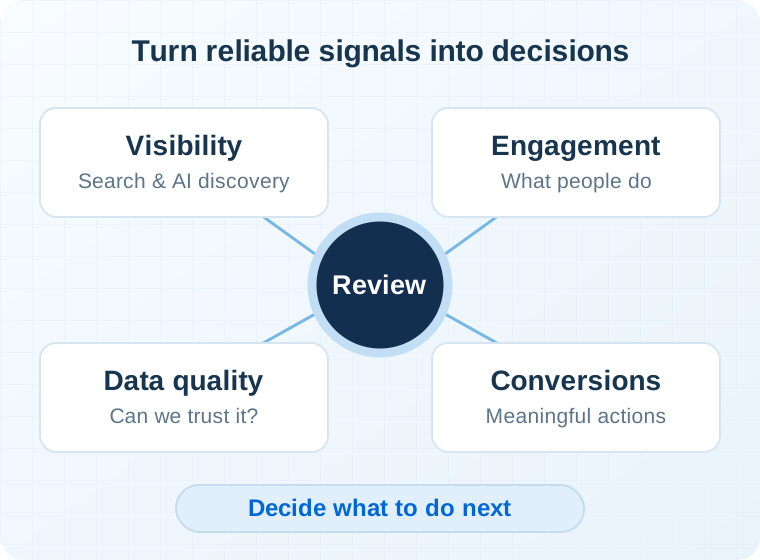
A supported submission method does not establish that your account is enabled, that every review will be displayed or that sales will improve. Separate delivery checks from the commercial outcomes you want to evaluate.
My recommended acceptance criteria would start with complete records, consistent identifiers, visible errors and clear ownership. After that, assess any change in product-page engagement or purchasing behavior using your existing measurement plan; the transport method alone is not evidence of a conversion gain.
If review delivery is part of a wider catalogue, migration or technical SEO challenge, share the context with RankWithMo. A useful first brief names the current review platform, the delivery method and the problem your team needs to resolve.